Black-market operators on Budapest's Airbnb market: one in three listings is suspicious
Every third Airbnb and Booking listing in Budapest conceals an irregularity. Antos Péter on black-market operators, the 5 taxes, and market clean-up.

What happens when a neighbour rents out their flat to tourists without registration or paying tax? And why is this bad not only for the building, but also for the hosts who operate properly and above board?
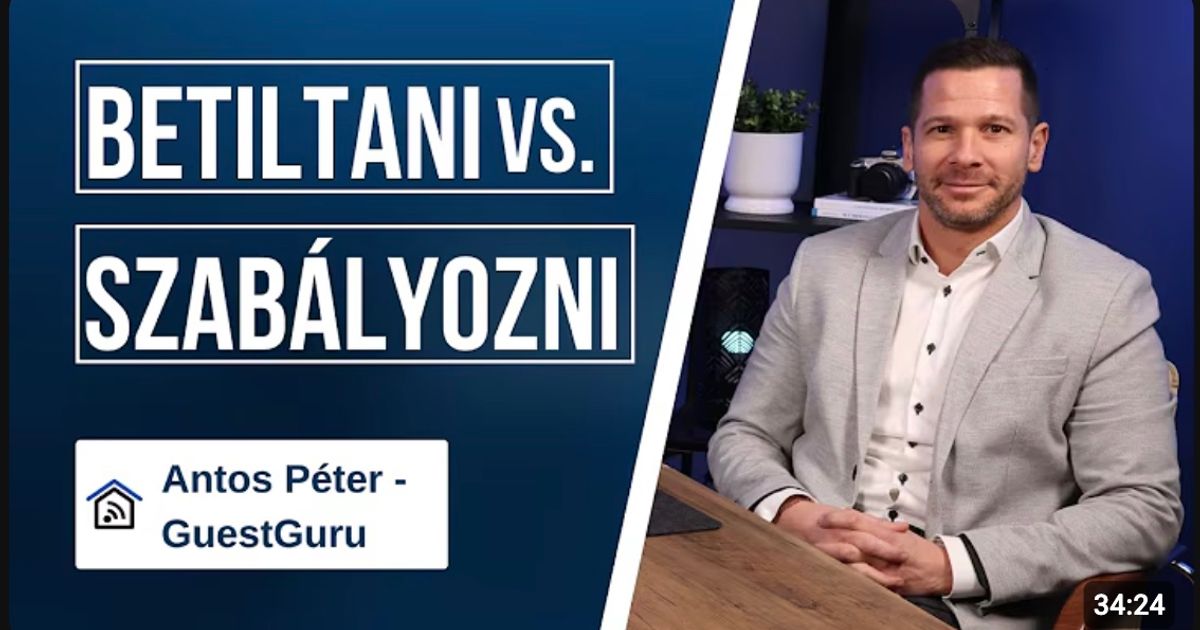
In the latest episode of the IngatlanFM podcastAntos Péter, co-owner and sales director of GuestGuru, spoke about perhaps the most sensitive topic in Budapest's short-term rental market: "black-market operators". That is, Airbnb and Booking hosts who skip the mandatory NTAK registration, invoicing, and tax payments. The conversation reveals that today roughly every third listing in Budapest involves some form of irregularity — and that this can finally be made visible.
We have gathered the key points. You can watch the full episode here:
▶️ Grey-zone accommodations and hosts on Hungary's Airbnb market (IngatlanFM)
https://www.youtube.com/watch?v=oO4OQm6vehs
What does "operating off the books" mean in the short-term rental market today?
Short-term rental has long since ceased to be the hobby it was a few years ago. Back then you put up a listing, a guest came along, you rented it out for the weekend, and that was that. Today it has become a serious, strictly regulated service: invoices must be issued, data must be reported, and several taxes must be declared.
Anyone who circumvents these obligations is referred to in the industry as a black-market operator. The most common case is a host advertising with a non-existent or invalid NTAK number, issuing no invoice, and paying none of the mandatory taxes.
The aim, however, is not to name and shame. As Antos Péter emphasised: the goal is not to discredit others, but to protect those who operate properly and cleanly, pay their taxes, and carry out the required administration.
The figures that say it all
In Budapest there are approximately15,000 short-term listingsin total on Airbnb and Booking. This represents roughly one and a half per cent of the city's one million flats. The problem is therefore considerably smaller than public discourse would suggest.
Of these 15,000 listings, however,more than 5,000involve some form of irregularity. That is roughly one in three. And we are not talking about typos here: even if we discount the one or two per cent who genuinely made a mistake with their number, a significant portion of the market is still advertising with invalid or missing data.
Four types of irregularity worth distinguishing
In the podcast, Antos Péter grouped the problematic listings into four categories:
- Invalid number.This is the largest group, with approximately 2,900 listings. The host provided an NTAK number that does not exist (for instance, a made-up sequence such as "1 2 3 4 5 6"). In practice, they never registered at all.
- Missing number.In approximately 1,800 listings, no registration number is shown at all, even though this has been mandatory on both Airbnb and Booking for two and a half years. On Booking, there are significantly more such cases than on Airbnb.
- Someone else's number.The host displays another person's valid registration number as their own. Antos Péter compared this to driving around with stolen number plates.
- Suspicious number.Other cases suspected of abuse. Fortunately, there are far fewer of these.
The key point is that all of these appear in publicly accessible databases available to anyone: the municipal licence register, NTAK registrations, and the listings themselves. It is just that, until now, nobody had cross-referenced them.
Five taxes that a compliant host pays
Why does operating off the books pay off at all? Because operating legitimately is not cheap. Today a short-term rental provider must account forfive different taxes:
- flat-rate tax (150,000 forints per room per year),
- VAT (on the platform commission, or 5 per cent in the absence of VAT exemption),
- tourism tax (4 per cent),
- tourism development contribution (4 per cent),
- in certain cases, building tax.
Three of these require a tax return. In total, this represents a burden of roughly12–15 per cent. Anyone who avoids this can rent out their flat at a correspondingly lower price.
And here is the crux of why this affects everyone. The black-market operator drives prices down, which makes it harder for the entire Budapest market to raise prices and harder to filter out the problematic, party-crowd type of guest. Yet a higher price is itself a quality filter: it attracts more discerning guests who treat the flat with greater respect, and residents in the building can sleep more peacefully. If you are curious about how much a flat can earn cleanly and legitimately, thisrevenue and profit calculatoris worth trying.
The BPDB: the Budapest database that makes the grey zone visible
Among the GuestGuru ownership team there is a software developer, so the team built something the authorities had not had before: a single system that cross-references publicly available databases. This is called theBPDB(Budapest Database).
The system shows how many listings exist, how many licences have been issued, and — broken down by district and platform (Airbnb, Booking) — where the listings with invalid, missing, third-party, or suspicious numbers are located. On a map, too.
One important point to clarify here: public shaming is not the aim. GuestGuru does not display sensitive data either. The goal is for the authorities (NAV, local councils, NTAK) to finally have a tool with which irregularities can be investigated in a targeted manner, and for those who have made mistakes to be given the chance to put things right.
The lesson of the sixth district
A good example is District VI, wherefrom 1 January 2026the operation of private and other accommodation will be prohibited (community accommodation and guesthouses may remain in certain cases). Before the ban, approximately 2,700 flats were operating there.
According to BPDB data, however, a large number of active listings remained in the district even after the ban came into effect. There is practically no street without a black-market operator. Some simply changed their listed address to a neighbouring district to avoid detection, but the system catches such tricks too.
Not punishment, but a chance to set things right
The most important message from the conversation is that this is not a witch-hunt. Starting from the presumption of innocence: anyone who has made a mistake now has the opportunity to put their operation in order and then continue operating legally just as before.
And for anyone who, for whatever reason, cannot register for short-term rental (because the residents' association prohibits it, or because the current moratorium means no new registration number is available), there is still a way forward.Medium- and long-term rentalcan be a perfect alternative for the very same property.
The market is capable of regulating itself if the rules of the game apply equally to everyone. That is why GuestGuru has made market clean-up a priority. Not to push anyone out, but so that short-term rental can finally be what it should be: a cleanly and responsibly operating market that is good for the host, the guest, the residential community, and the city alike.
Frequently asked questions about black-market operators and NTAK numbers
What is an NTAK number and why is it mandatory?
The NTAK (National Tourism Data Centre) registration number identifies the accommodation. It has been mandatory to display it on Airbnb and Booking for two and a half years. Without it, a listing is deemed irregular and may be subject to investigation.
How do I know whether someone else is using my NTAK number?
The BPDB is designed to make exactly this kind of abuse visible. GuestGuru plans to make a search tool available where anyone can check whether someone is using their own registration number on the market.
How much tax does a compliant short-term accommodation pay?
In total, five types of tax may arise (flat-rate tax, VAT, tourism tax, tourism development contribution, and building tax), amounting to a burden of roughly 12–15 per cent. Three of these require a tax return.
What can I do if I cannot rent out my flat on a short-term basis?
If the residents' association prohibits it, or if no new registration is available due to the moratorium, medium- and long-term rental can be a good alternative. We can also help you find the right solution.
If you would like to rent short-term in a clean, lawful, and stress-free manner, or if you are considering whether medium- or long-term rental might be a better use of your property,get in touch with the GuestGuru team. We will help you find the best solution for you.
Curious about your apartment's potential?
Work out in 2 minutes how much your apartment could earn on the current Budapest market.
Revenue CalculatorRelated
Keep reading on this topic

NTAK numbers and Budapest restrictions in the podcast
Podcast on restrictions on short-term rentals in Budapest, problematic NTAK numbers and irregular listings.
19 Aug 2026
GuestGuru on the Ingatlan.fm podcast: Antos Péter on the future of Budapest Airbnb
Interested in Airbnb property management? Antos Péter speaks on Ingatlan.fm about the Budapest market, regulations and the future of Airbnb property management.
17 Mar 2026

GuestGuru on the Ingatlan.fm podcast: announcement
We're launching a regular podcast series about Airbnb management with Ingatlan.fm!
6 Mar 2026