Budapest's housing stock
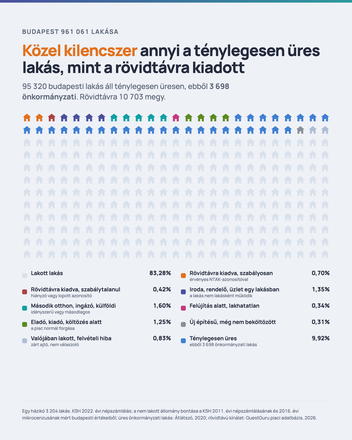
Nearly nine times as many homes stand genuinely empty as are let short-term
95,320 Budapest homes stand genuinely empty, 3,698 of them council-owned. 10,703 go to short-term rental. Below: the chart, the derivation of every number, and a comparison that says more about the housing shortage than short-term rental does.
Every home in Budapest, on three hundred little houses
One little house stands for 3,204 homes. Short-term rentals are the two orange houses and the red one: together 1.11% of the entire stock.
Where each number comes from
The breakdown uses four kinds of data. Measured numbers come from direct data; held-at-measured-level ones from the Budapest values of the HCSO's 2011 census and 2016 microcensus; calculated ones from transaction data; and for estimated ones there is no data source at all, so we give a range.
Office or short-term rental?
If we want to win homes back for the housing market, it is worth looking at where more of them are. All three numbers come from the same breakdown.
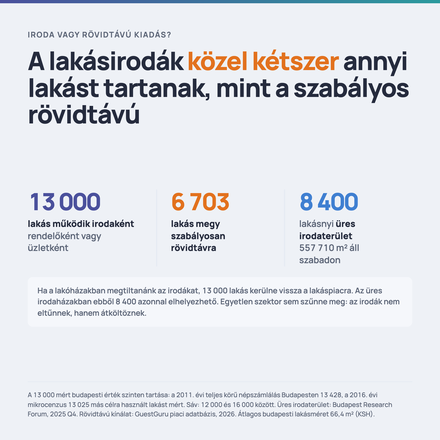
13,000
homes operate as offices, surgeries or shops
6,703
homes are let short-term lawfully, with a valid NTAK identifier
8,400
homes' worth of vacant office space is available: 557,710 m²
What would happen if we banned offices in residential buildings? 13,000 homes would return to the housing market. That is nearly twice the number of lawfully let short-term rentals, and it exceeds the entire short-term supply by a fifth.
Most of the displaced offices would not even need a new building: the vacant modern office space provides room for 8,400 homes, meaning 65% of the 13,000 home offices could be accommodated immediately in office buildings that are empty today. The remaining 4,600 would have to find another solution, possibly over several years.
In this scenario no sector disappears: the law firm, the doctor's surgery and the massage studio do not vanish, they move. Compared with banning short-term rental — which affects an entire industry and the tens of thousands who work in it — this brings back nearly twice as many homes.
What you need to know about the 13,000. This is not a ratio projected onto Budapest but a measured Budapest value: the full 2011 census found 13,428 homes used for other purposes and the 2016 microcensus 13,025, and we hold that level for 2022 as well. Range: between 12,000 and 16,000. Besides offices and surgeries it may include corporate guest flats and company-owned investments, so not all of them could be moved out.