Illegal Short-Term Rentals in Budapest: What Does the BPDB Reveal?
According to BPDB data, thousands of short-term rental listings in Budapest may be irregular, whilst enforcement by the authorities remains patchy.

How many times have we heard recently that Airbnb is to blame for everything, and that restricting short-term rentals is inevitable? GuestGuru has conducted a comprehensive audit of the inner districts using its proprietary BPDB (Budapest Database) system. We examined nearly 9,000 Airbnb and more than 5,000 Booking.com listings. We cross-referenced these with official municipal and accommodation classification registries, and the results were dismal.
The Numbers Don't Lie: This Is How Under-the-Radar Letting Thrives in Budapest
The most painful truth for hosts who operate legally and pay their taxes honestly is that the districts are full of those working off the books:
- District V:There are 1.76 times more active listings than official municipal permits. This means that nearly twice as many properties are being let out as have the proper paperwork.
- Districts VIII and IX:In these districts too, this multiplier exceeds 1.3.
- District VI (Terézváros):Although the local council communicates the ban as a successful measure, and a full moratorium exists on paper, in reality several hundred illegal listings remain accessible.
The situation makes it abundantly clear that the problems have persisted, yet the local authority is losing out on tax revenue. Those who complied with the law and closed their accommodation have been placed at a disadvantage, whilst those who went underground even enjoy a tax advantage over operators who run their business legally.
When We Offer Help for Free: The Wall of Bureaucracy
Beyond measurement, taking action was also our goal: we contacted the authorities through official submissions, reaching out to the registrars of the inner districts as well as the Chief Registrar of Budapest. We offered the use of our BPDB system free of charge to help filter out violations, but instead of meaningful action, we encountered bureaucracy and stonewalling at every turn:
- NTAK / Visit Hungary:They confirmed in writing that they do not arrange for listings to be removed; closing down irregular accommodation and imposing fines is the responsibility of the district registrars.
- Accommodation Classifiers (MTMT):They clarified that they are solely responsible for categorisation. In their view, they have no regulatory authority to impose penalties, and filtering out listings with fictitious NTAK numbers is entirely the registrar's responsibility.
- NAV:In response to our enquiry regarding widespread tax evasion, they replied that the matter falls within the jurisdiction of the registrars.
- District VII (Erzsébetváros):We reported specific listings running with stolen NTAK numbers. According to the registrar's response, the numbers in the listings were "corrected", but citing business confidentiality, they refused to disclose whether any penalty had been imposed. They also stated that they do not accept external databases as evidence and have no wish to cooperate with professional organisations.
- District VIII (Józsefváros):We offered our BPDB filtering system free of charge, but it was rejected on the grounds that the council already has a live contract with an external company. Through our freedom of information request, it emerged that the council pays a gross fee of 381,000 HUF every six months for this service. According to the council, their system is working, whilst BPDB data indicates that 786 listings in Józsefváros (approximately 31% of market supply) are still operating illegally or irregularly.
We at GuestGuru believe in fair competition. We want a transparent market environment where operating legally means stability and profit, not a competitive disadvantage. Whilst we have no desire to act as a "voluntary police force", we are certain that the tense situation is caused by those who deliberately cheat the system by working off the books, yet it is ultimately we — the legal sector — who pay the price of collective bans.
Please Note!In May, Booking.com deleted the NTAK numbers that accommodation providers had set up, due to a technical error, causing approximately 95% of listings to become technically non-compliant. In our next article, coming soon, we will walk you through the restoration process step by step!
Curious about your apartment's potential?
Work out in 2 minutes how much your apartment could earn on the current Budapest market.
Revenue CalculatorRelated
Keep reading on this topic
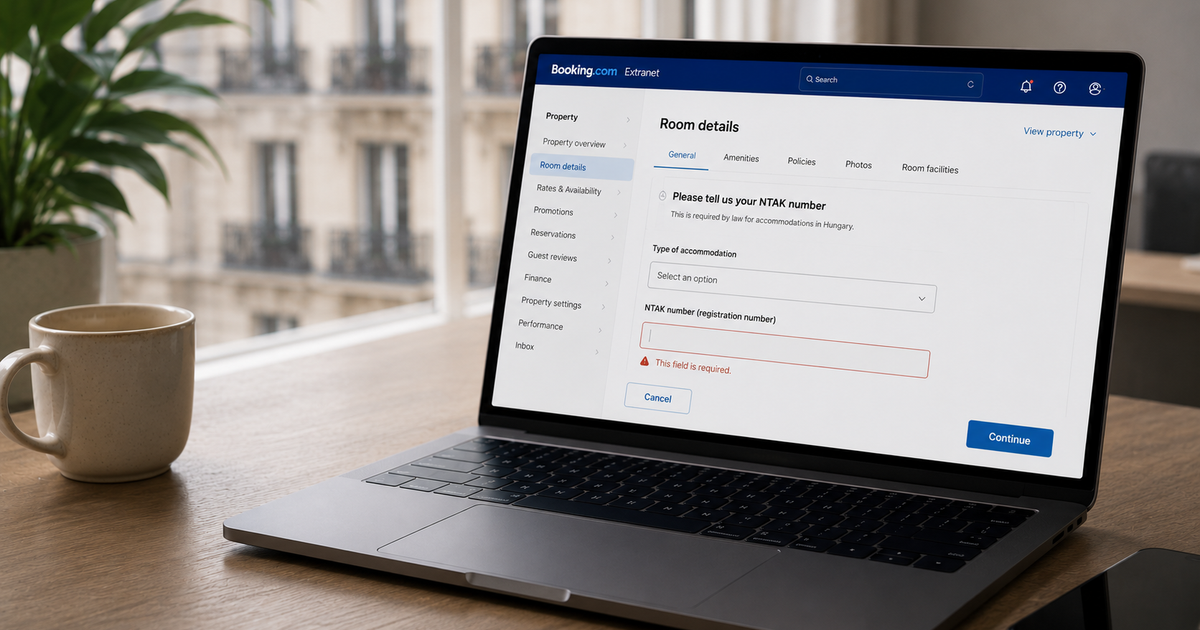
Missing your NTAK number on Booking.com? Here's how to fix it!
Has your NTAK number disappeared from your Booking.com listing? Follow our step-by-step guide and restore it quickly.
29 Jul 2026

Changes to Airbnb Service Fees: What Does This Mean for Individual Hosts?
Airbnb is switching to a 15.5% fee model. Find out how to reprice your listing to maintain your previous net income.
17 Jul 2026

SZJA tax return 2025 for apartment landlords: what to watch out for by 20 May
The deadline for the 2025 SZJA tax return is 20 May 2026. What do apartment landlords need to know about itemised flat-rate tax and eSZJA?
7 May 2026